[Literature Share] Research Progress of Vitamin E Stabilized Highly Cross‑Linked UHMWPE for Orthopaedic Joint Prostheses
Vitamin E stabilized highly cross-linked ultra-high-molecular-weight polyethylene (VEPE) is a polyethylene material that has attracted extensive attention in the field of orthopaedic joint prostheses in recent years. It is developed by incorporating vitamin E (α-tocopherol) into highly cross-linked ultra-high-molecular-weight polyethylene (HXLPE). Cross-linking endows the material with outstanding wear resistance, while vitamin E inhibits oxidative degradation triggered by residual free radicals generated during the cross-linking process. Focusing on VEPE, this paper reviews the research progress of the material from the perspectives of its development background, antioxidant mechanism, manufacturing processes, as well as clinical and wear debris studies.
HXLPE is produced by increasing the crosslinking degree between UHMWPE molecular chains via irradiation and other methods. It was originally developed to address the wear issue of conventional UHMWPE under long-term service. Nevertheless, while irradiation crosslinking improves wear resistance, it generates free radicals within the material. Long-term retention of these free radicals can trigger oxidative chain reactions in an oxygen-rich environment, accompanied by molecular chain scission, which ultimately degrades material properties[1].
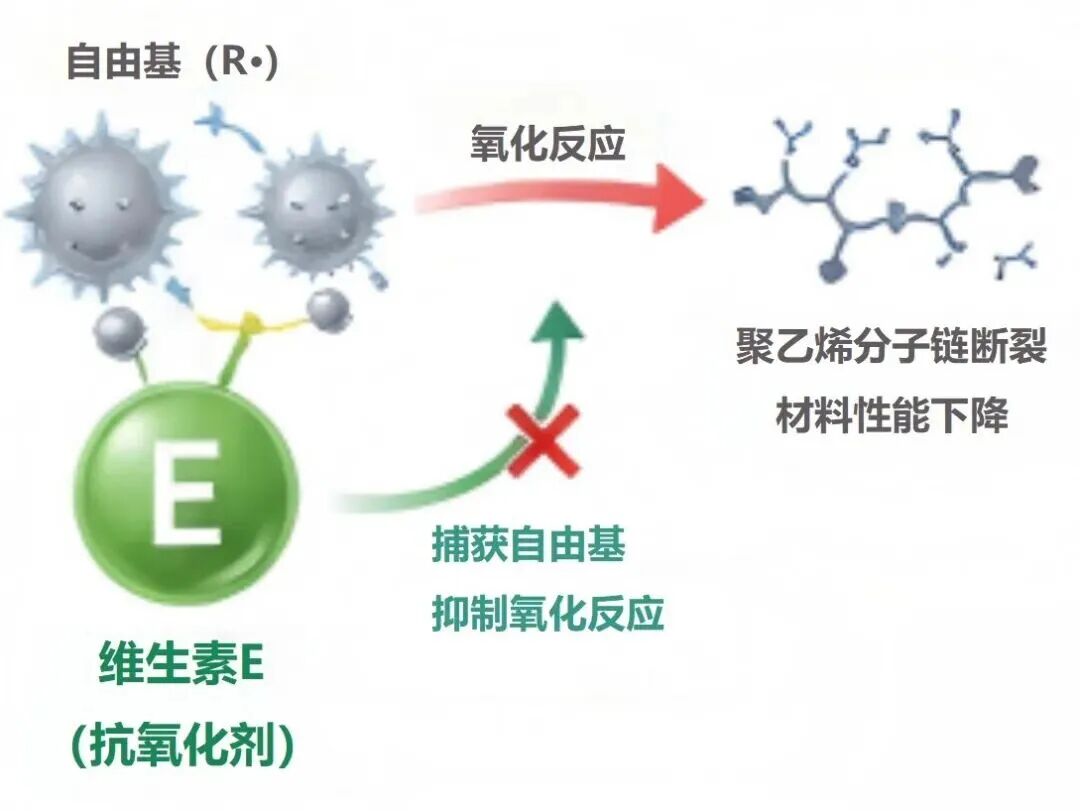
The conventional approach is post-irradiation melt thermal treatment to eliminate residual free radicals, yet this process compromises certain mechanical properties, especially fatigue strength[1]. The incorporation of vitamin E offers a new solution to this dilemma: it preserves the wear resistance conferred by crosslinking while enhancing the material’s oxidation resistance. As summarized by Xian Jie and He Benxiang, vitamin E reacts with free radicals within the material, reducing the likelihood of subsequent oxidative reactions of polyethylene and improving its oxidative stability[2].
At present, there are two primary fabrication routes to introduce vitamin E into HXLPE. Route 1: irradiation followed by diffusion. After polyethylene is formed and irradiated, vitamin E diffuses into the bulk material, and homogenization treatment is performed subsequently. Route 2: mixing prior to processing. Polyethylene is blended with vitamin E at the raw material stage, followed by forming and post-processing.
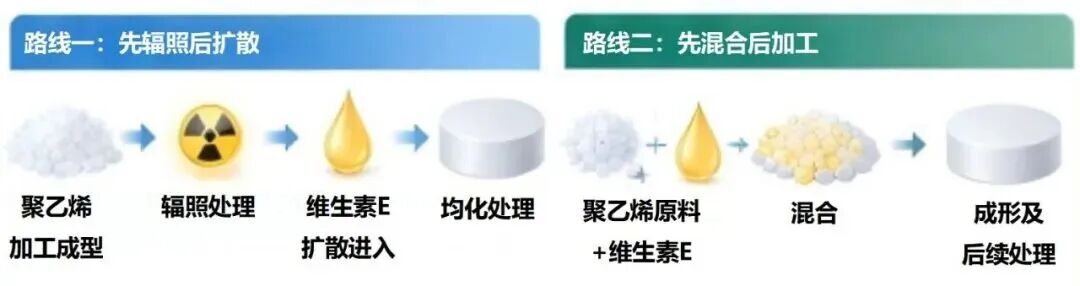
These two routes govern the distribution and concentration of vitamin E within the material, and ultimately determine its properties. Bracco and Oral noted in their review that VEPE exhibits superior antioxidant capacity compared with irradiated UHMWPE retaining residual free radicals. Its wear resistance is comparable to that of irradiated and melt-annealed UHMWPE, while its mechanical strength is higher. In addition, biocompatibility has been verified by elution tests simulating antioxidant leaching from implants[1]. Further long-term follow-up data are still required to identify whether there are in vivo performance differences between components manufactured by the two routes.
Clinically, Spece et al. reviewed 13 studies investigating the in vivo performance of VEPE in total knee arthroplasty. In terms of revision rate, patient-reported outcome scores, and incidence of osteolysis and radiolucent lines, VEPE performed similarly to conventional UHMWPE and non-VE HXLPE. Retrieval analyses demonstrated favorable antioxidant performance, with surface damage patterns comparable to those of conventional polyethylene. No cases of osteolysis or revisions attributable to polyethylene wear were reported, indicating favorable early-to-mid-term clinical performance[3].
Notably, low-wear materials such as VEPE raise new issues for wear debris assessment methods. Zheng Ye et al. conducted wear debris isolation and extraction experiments using VEPE knee prostheses. The quantity of debris recovered following current standard protocols was insufficient for quantitative, volumetric and morphological characterization. Increasing the volume of digestive fluid significantly improved debris recovery, making the modified protocol more suitable for low-wear VEPE debris[4]. This suggests that methodologies for wear debris extraction and characterization need to be adapted alongside the adoption of low-wear polyethylene materials.
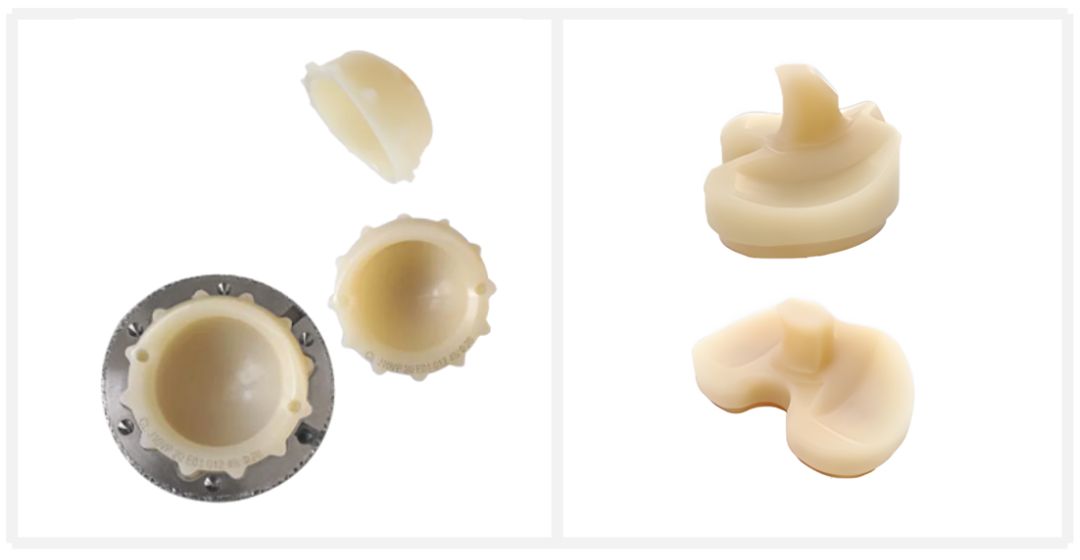
(a) VEPE Acetabular Liner (b) VEPE Tibial Insert
Selected Clinical VEPE Implant Applications of Chunli Medical
At present, VEPE has been adopted in the Company’s hip and knee product lines. Load-bearing and articulating components such as acetabular liners for hip prostheses and tibial inserts for knee prostheses are manufactured from this material (see figure above). From the perspective of material evolution, VEPE retains the wear resistance derived from crosslinking, while vitamin E mitigates the long-term oxidation risk induced by residual free radicals. It represents a material strategy combining wear resistance and oxidation stability[1][2]. As its clinical use in hip and knee arthroplasty expands and follow-up data accumulate, the long-term benefits of VEPE will be further validated[3].
[1] Bracco P, Oral E. Vitamin E-stabilized UHMWPE for total joint implants: a review[J]. Clinical Orthopaedics and Related Research, 2011, 469(8): 2286-2293.
[2] Xian J, He B X. Research progress of vitamin E stabilized cross-linked ultra-high molecular weight polyethylene in joint replacement[J]. Chinese Journal of Tissue Engineering Research, 2016, 20(31): 4707-4712.
[3] Spece H, Yarbrough R V, Kurtz S M. A Review of Early In Vivo Performance of Antioxidant Stabilized Polyethylene for Total Knee Arthroplasty[J]. The Journal of Arthroplasty, 2023, 38(9): 1885-1891.
[4] Zheng Y, Huang X L, Feng J, Zhu J J, Hua Z K. Isolation and extraction of wear debris from vitamin E stabilized highly cross-linked polyethylene total knee prostheses[J]. Journal of Shanghai University (Natural Science Edition), 2023, 29(2): 200-210.
Corrections are welcome for any mistakes. Content will be removed if copyright issues are identified.